Key takeaways
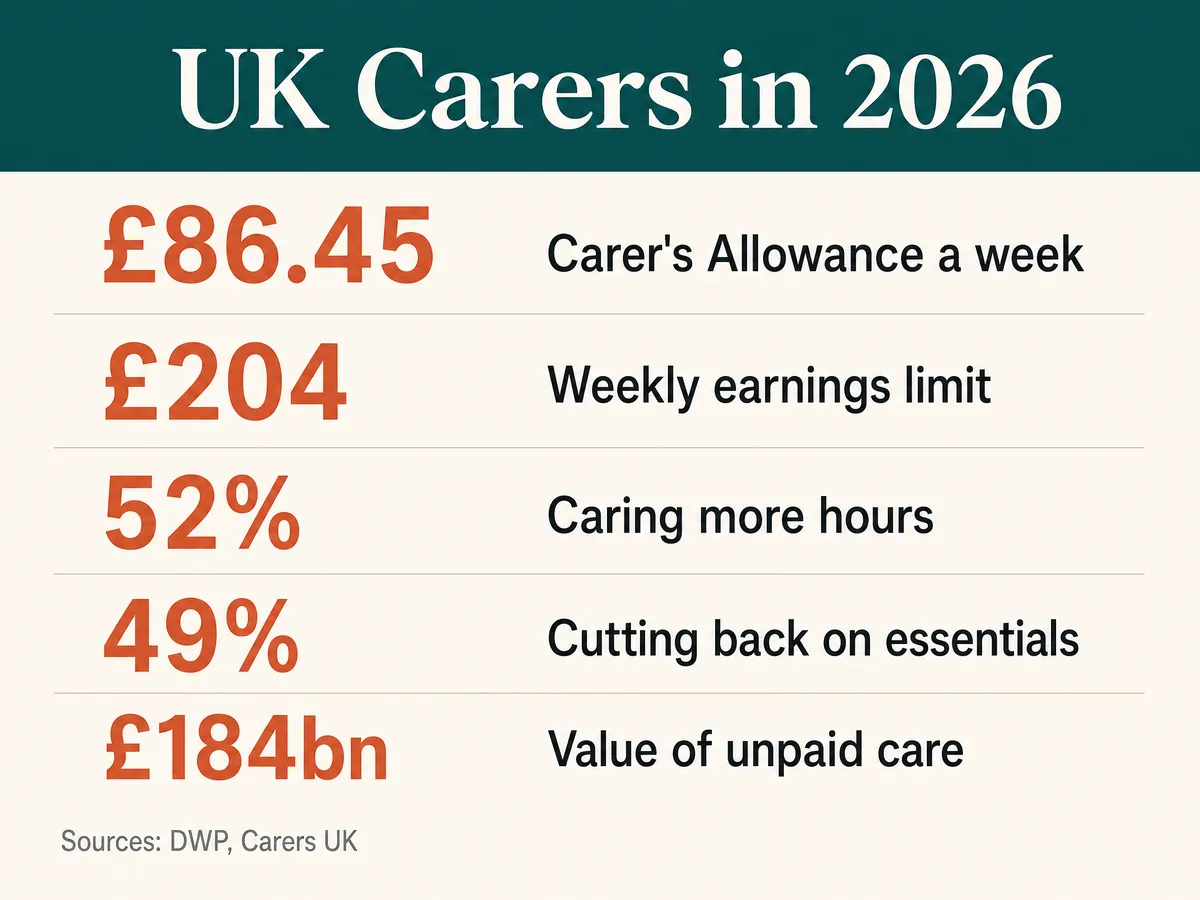
- → £86.45 a week Carer's Allowance in 2026/27, with a £204 weekly earnings limit (DWP).
- → 52% of carers are providing more hours of care than a year ago (Carers UK, 2025).
- → 49% have cut back on essentials such as food and heating (Carers UK, 2025).
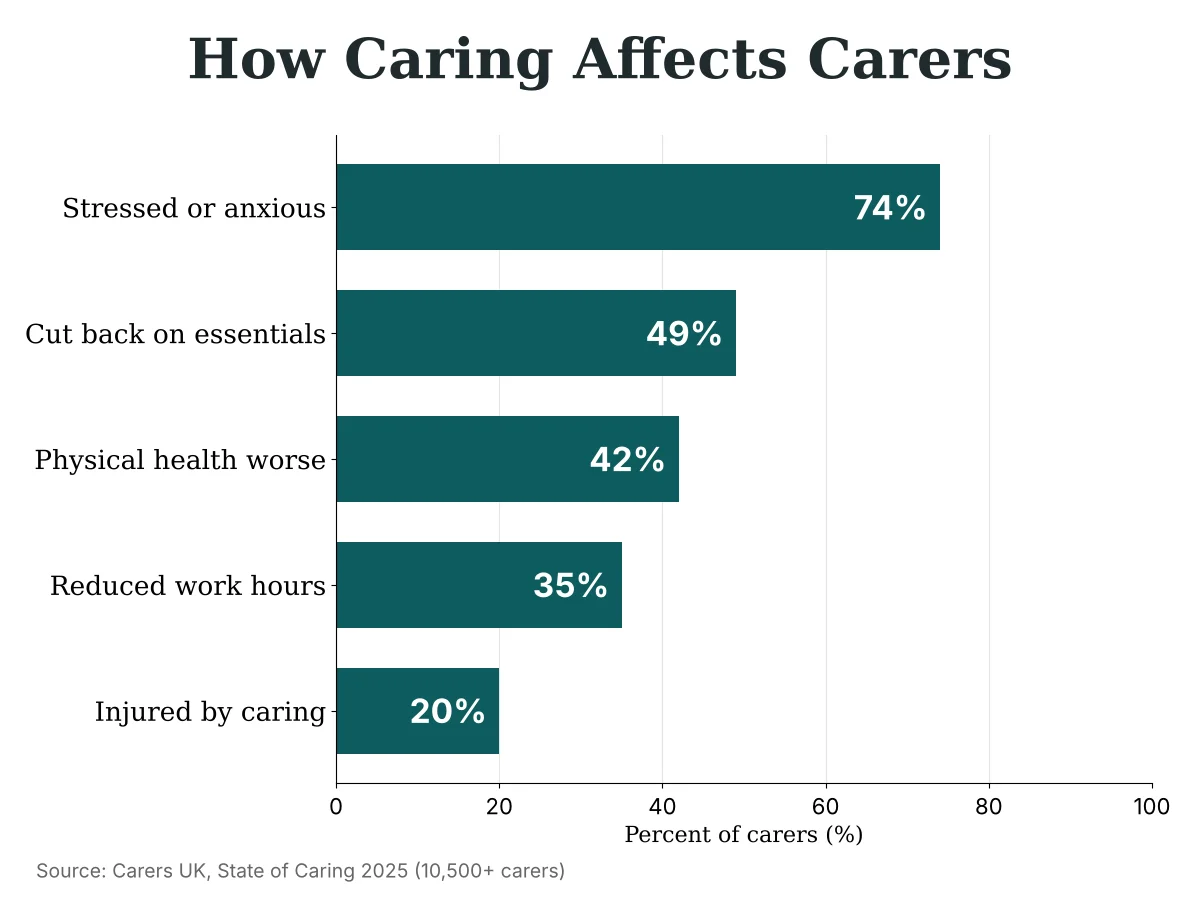
- → 42% say their physical health has got worse, and 20% have been injured caring (Carers UK, 2025).
- → Free: a carer's assessment, open to anyone over 18 who cares regularly (NHS).
- → £150 plus an apology: the Ombudsman's remedy when Merton and Croydon councils missed carer's assessments (2025–26).
- → 45% of carers in a Healthwatch Northumberland survey (published May 2026) had no short break in a year.

Support for carers in the UK comes in five forms: money, a free carer's assessment, breaks, rights at work and grants to adapt the home. Not every carer gets all of it. Carer's Allowance rose to £86.45 a week in April 2026,[1] yet only 36.7% of carers known to councils in England say they are very or extremely satisfied with the support they get.[7]This guide sets out what each type of carer support service offers in 2026, what happens when councils fail to provide it (shown through two real Ombudsman cases), and how to check what you may be missing.
1Five types of support for carers
Most help reaches carers through the benefits system, the local council or an employer. Here is what each provides.
| Metric | Value | Source |
|---|---|---|
| Money: Carer's Allowance | £86.45/week | DWP 2026/27[1] |
| Council: carer's assessment | Free | NHS[8] |
| Breaks: Wales Short Breaks Scheme | £3.5m | Welsh Government, 2025-26[11] |
| Work: carer's leave | 1 week/year | Carer's Leave Act 2023[9] |
| Home: Disabled Facilities Grant (England) | Up to £30,000 | GOV.UK[17] |
These forms of support link together. A carer's assessment can lead to breaks, and the benefit the person you care for receives decides whether you can get Carer's Allowance. If you're supporting a parent, our guide to helping elderly parents stay independent at home covers the practical side, and the signs that stairs are becoming unsafe can help you decide when to raise home adaptations.
22026/27 carer benefits: £86.45 a week and a £204 earnings limit
Carer benefits rose in line with inflation (CPI) in April 2026, and the Carer's Allowance earnings limit went above £200 a week for the first time.[2]
| Metric | Value | Source |
|---|---|---|
| Carer's Allowance (was £83.30) | £86.45/week | DWP[1] |
| Earnings limit (was £196) | £204/week | DWP[1] |
| Universal Credit carer element | £209.34/month | Carers UK[2] |
| Carer premium / Pension Credit carer addition | £48.15/week | DWP[1] |
| Scotland: Carer Support Payment | £86.45/week | Carers UK[3] |
| Scottish Carer Supplement | +£11.70/week | Carers UK[3] |
| Attendance Allowance (cared-for person) | £76.70 / £114.60 | DWP[1] |
a week is the minimum amount of caring for Carer's Allowance. You must be 16 or over, and the person you care for must get a qualifying benefit such as Attendance Allowance, PIP daily living or the middle or highest care rate of DLA.[15]
GOV.UK Carer's Allowance eligibility.
Attendance Allowance is worth checking early. It is for people over State Pension age who have needed help with personal care or supervision for at least six months.[16]Once the person you care for receives it, you may be able to claim Carer's Allowance. If you're buying equipment, our guide to stairlift finance explains monthly payment options.
3The carer's assessment: free, and reviewed every year
A carer's assessment is the gateway to council support for carers. It is free, and anyone over 18 who regularly looks after someone can ask for one.[8]
| Metric | Value | Source |
|---|---|---|
| Cost | Free | NHS[8] |
| Who can ask | Anyone 18+ | NHS[8] |
| Review | At least yearly | Care Act guidance, cited by LGSCO[13] |
| Carers very or extremely satisfied with support (England) | 36.7% | NHS England, 2023-24[7] |
| Carers who feel they neglect themselves | 20.2% | NHS England, 2023-24[7] |
The assessment looks at how caring affects your physical and mental health, work, free time and relationships. The NHS lists the kinds of help it can lead to: someone to take over caring so you can take a break, gym membership or exercise classes, taxi fares, help with gardening and housework, training to lift safely, and benefits advice.[8]Under the Care Act, the council must assess any carer who appears to need support, and the assessment should be reviewed at least once a year, or sooner if circumstances change.[13]
of carers known to councils in England reported significant financial difficulty in 2023-24, up from 8.8% in 2021-22.[7]
NHS England, Survey of Adult Carers 2023-24.
4Real cases: when councils get it wrong
When a council fails to assess a carer, the Local Government and Social Care Ombudsman can order it to put things right. These two recent decisions show what that looks like in practice.
Real case
Merton: a mother caring for her adult son
Ms X cares for her adult son. She asked for the outcome of her carer's assessment in January 2025. When her son's circumstances changed significantly in April 2025, the council did not review her assessment. The Ombudsman upheld her complaint, finding that the delay "was fault, which caused Ms X distress and uncertainty." The council had to apologise, pay her £150 and give her an updated carer's assessment and support plan.
LGSCO decision 25 009 890, 9 June 2026[13]
Real case
Croydon: a missed annual assessment and a lost grant
Mrs X's annual carer's assessment was not completed in 2023, so she was not considered for the carer's grant she had received in other years. The Ombudsman found that she "did not receive a suitable assessment, nor proper consideration of eligibility for the associated annual carer's grant in 2023." Croydon had to apologise and pay her £150, plus the amount of the grant she would probably have received.
LGSCO decision 24 009 949, 20 March 2025[14]
In both cases, the council failed to complete or review an assessment it owed. Keep a record of when you contacted the council, ask for your assessment outcome in writing, and request a review whenever the needs of the person you care for change, for example after a hip or knee operation.
545% of carers go a year without a short break
Breaks are among the support carers miss most, often because they don't know breaks are available.[12]
| Metric | Value | Source |
|---|---|---|
| No short break in the last 12 months | 45% | Healthwatch Northumberland, 2026 (167 carers)[12] |
| No longer break in the last 12 months | 76% | Healthwatch Northumberland, 2026[12] |
| Non-break takers unaware of options | 33% | Healthwatch Northumberland, 2026[12] |
| Wales Short Breaks Scheme users caring 50+ hrs/week | 80% | Welsh Government[11] |
"Trying to get planned respite care is hard work and I am finding it increasingly impossible." Carer, Healthwatch Northumberland survey[12]
"I think I would be a better carer as I'd have time to rest and recover." Carer, Healthwatch Northumberland survey[12]
The Healthwatch figures come from one area. In Wales, almost half the carers who used the government's break and support schemes in the past three years had not previously been known to services.[11]Guilt is a common barrier: "Taking a break just means having to push the responsibility on another member of the family and that makes me feel guilty," one carer told Healthwatch.[12] A break is something to ask for in your carer's assessment.
6Work, carer's leave and the overpayment problem
Working carers have a legal right to one week of unpaid carer's leave a year, from their first day in a job.[9]
| Metric | Value | Source |
|---|---|---|
| Carer's leave entitlement | 1 week/year | Carer's Leave Act 2023[9] |
| In force since | 6 Apr 2024 | Carers UK[9] |
| Working carers who cut their hours | 35% | Carers UK, 2025[4] |
| Took a lower-paid or more junior role | 21% | Carers UK, 2025[4] |
| Surveyed Carer's Allowance recipients overpaid | 1 in 10 | Contact[10] |
| Average overpayment repaid | £1,045 | Contact[10] |
You can take carer's leave in half days, full days or a whole week. Give three days' notice for a single day or half day, or twice as many days' notice as the leave you want.[9]If you earn close to the £204 limit, track your earnings every week. An independent review published in November 2025 found that large numbers of carers were left with big overpayments because of the DWP's own failures. The government is reassessing cases from 2015 to 2025 that involved averaged earnings.[10]
7Why support matters: 74% of carers feel stressed or anxious
Caring is getting harder. Carers UK's 2025 survey of more than 10,500 carers found 52% were caring for more hours than a year before.[4]
a year is the value of unpaid care in the UK, equivalent to a second NHS and up 29% since 2011.[5]
Centre for Care / Carers UK, Valuing Carers, November 2024 (latest published estimate).
The 2021 Census counted 5.0 million unpaid carers in England and Wales, 1.5 million of them caring for 50 or more hours a week.[6] Wales had a higher share, at 10.5% of people compared with 8.9% in England. Injuries are common. One in five carers has been hurt while caring,[4] so ask for lifting training through your assessment, and if stairs are a struggle, read whether a stairlift would fit your stairs.
8Carer support checker
Answer ten quick questions to see which carer support services and benefits may be worth checking. It takes about a minute.
Answer what you can. Your answers stay on your device and nothing is sent anywhere.
Do you care for someone for 35 hours a week or more?
Does the person you care for get Attendance Allowance, PIP daily living or DLA (middle or highest care rate)?
Do you earn £204 a week or less after tax, National Insurance and expenses (or not work at all)?
Do you live in Scotland?
Is the person you care for over State Pension age and has needed help with personal care or supervision for 6 months or more?
Do they already get Attendance Allowance?
Have you had a carer's assessment (or a review) from your council in the last 12 months?
Have you had a break from caring in the last 12 months?
Are you employed?
Does the person you care for struggle with the stairs or other parts of their home?
Your results will appear here
This checker is a guide based on GOV.UK eligibility rules and 2026/27 rates. It is not a benefits decision. Always check the official rules or speak to a benefits adviser before claiming.
9Practical tips for families
These steps come straight from the rules and cases above.
- Ask for a carer's assessment in writing, and ask for a review whenever needs change. Councils should review at least once a year.[13]
- Check Attendance Allowance first if the person you care for is over State Pension age. It can unlock Carer's Allowance for you.[16]
- Keep weekly earnings records if you earn near £204 a week, to avoid overpayments.[10]
- Put breaks on the agenda. Ask for someone to cover your caring in your assessment.[8]
- Use carer's leave for appointments and emergencies. It is a day-one right.[9]
- Make the home safer. Ask about a Disabled Facilities Grant before paying for adaptations yourself.[17]
If stairs are the problem, our guide to how much stairlifts cost covers prices, VAT relief and grants. A reconditioned stairlift is the cheapest option if you pay yourself, and our cost estimator gives a quick guide price.
10Methodology
We researched this guide on 4 October 2026 and cite 17 sources. Seven are dated 2026, including the 2026/27 benefit rates, the Merton Ombudsman decision and the Healthwatch report. Five are from 2025: the Carers UK rates announcement, State of Caring, the overpayments coverage, Welsh Government funding and the Croydon decision. The Carer's Leave Act guidance reflects current law. Older sources are included because they are still the latest official versions: the NHS carer's assessment guidance, the 2023-24 Survey of Adult Carers (published June 2024), Valuing Carers (November 2024) and the 2021 Census. We used only published, attributed case studies. Carer quotes come from the Healthwatch Northumberland report, which is a local survey of 167 carers and is labelled as such. We found no reliable national figure for how many carers receive an assessment each year, so we have not given one. We'll update this page each April when benefit rates change.
Frequently asked questions
What support is available for carers in the UK?+
The main types are money (Carer's Allowance is £86.45 a week in 2026/27), a free carer's assessment from your council, breaks from caring, the right to one week's unpaid carer's leave a year from your employer, and grants to adapt the home of the person you care for. An assessment can lead to help such as someone to cover your caring so you can take a break, taxi fares or training to lift safely.
How much is Carer's Allowance in 2026?+
Carer's Allowance is £86.45 a week from April 2026, up from £83.30 (DWP). You can earn up to £204 a week after tax, National Insurance and expenses and still qualify. In Scotland, Carer's Allowance has been replaced by Carer Support Payment, also £86.45 a week, plus a Scottish Carer Supplement of £11.70 a week.
What is a carer's assessment and is it free?+
A carer's assessment is a conversation with your council about how caring affects your health, work, free time and relationships. It is free, and anyone over 18 who regularly looks after someone can ask for one (NHS). Under the Care Act, councils must assess carers who may need support, and should review the assessment at least once a year or sooner if things change.
What can I do if the council won't assess me?+
Complain to the council first, then to the Local Government and Social Care Ombudsman. In two recent cases, the Ombudsman found Merton and Croydon councils at fault for missed carer's assessments. Each carer received an apology and £150. In the Croydon case, the carer also received the carer's grant she would probably have got that year.
Can I take time off work to care?+
Yes. Since 6 April 2024, the Carer's Leave Act gives employees one week of unpaid leave a year to care for a dependant, from their first day in the job. You can take it in half days, full days or a whole week. You need to give at least three days' notice for a single day or half day, or twice as many days' notice as the leave you want.
How do I get a break from caring?+
Ask for a carer's assessment, which can recommend someone to take over your caring so you can have a break (NHS). Many carers don't know breaks are available. In a Healthwatch Northumberland survey published in May 2026, 45% of carers had no short break in a year, and a third of those who didn't take one were unaware of the options. In Wales, the Short Breaks Scheme has £3.5 million for 2025-26.
Could I have been overpaid Carer's Allowance?+
Possibly, if your earnings went over the limit (now £204 a week). Research by the charity Contact found 1 in 10 surveyed Carer's Allowance recipients had been overpaid, with average repayments of £1,045. After an independent review published in November 2025, the government is reassessing cases from 2015 to 2025 that involved averaged earnings.
Sources
- DWP. "Benefit and pension rates 2026 to 2027." https://assets.publishing.service.gov.uk/media/69931706ceeaa48d377f6bd5/Benefit-and-pension-rates-2026-2027.pdf. Accessed 4 October 2026.
- Carers UK. "Government confirms benefit increases for 2026-27 (28 Nov 2025)." https://www.carersuk.org/press-releases/government-confirms-benefit-increases-for-2026-27-including-rise-in-carer-s-allowance-and-earnings-threshold. Accessed 4 October 2026.
- Carers UK. "Carer Support Payment factsheet 2026-27." https://www.carersuk.org/media/pekdqk1u/carer-support-payment_2026-27.pdf. Accessed 4 October 2026.
- Carers UK. "State of Caring 2025: The cost of caring (21 Oct 2025)." https://www.carersuk.org/reports/state-of-caring-2025-the-cost-of-caring-the-impact-of-caring-across-carers-lives/. Accessed 4 October 2026.
- Centre for Care / Carers UK. "Valuing Carers (Nov 2024)." https://www.carersuk.org/reports/valuing-carers/. Accessed 4 October 2026.
- ONS. "Unpaid care, England and Wales: Census 2021." https://www.ons.gov.uk/peoplepopulationandcommunity/healthandsocialcare/healthandwellbeing/bulletins/unpaidcareenglandandwales/census2021. Accessed 4 October 2026.
- NHS England. "Personal Social Services Survey of Adult Carers in England, 2023-24." https://digital.nhs.uk/data-and-information/publications/statistical/personal-social-services-survey-of-adult-carers/england-2023-24. Accessed 4 October 2026.
- NHS. "Carer's assessments." https://www.nhs.uk/conditions/social-care-and-support-guide/support-and-benefits-for-carers/carer-assessments/. Accessed 4 October 2026.
- Carers UK. "The Carer's Leave Act 2023." https://www.carersuk.org/help-and-advice/work-and-career/the-carers-leave-act-2023/. Accessed 4 October 2026.
- Contact. "Government to reassess Carer's Allowance overpayments (Nov 2025)." https://contact.org.uk/about-contact/news-and-views/government-responds-to-damning-review-of-carers-allowance-overpayments/. Accessed 4 October 2026.
- Welsh Government. "£5.25m Welsh Government funding to benefit unpaid carers (Feb 2025)." https://www.gov.wales/525m-welsh-government-funding-benefit-unpaid-carers. Accessed 4 October 2026.
- Healthwatch Northumberland. "Taking a break (May 2026)." https://healthwatchnorthumberland.co.uk/wp-content/uploads/2026/05/Healthwatch-Northumberland-taking-a-break-report-May-2026.pdf. Accessed 4 October 2026.
- Local Government and Social Care Ombudsman. "London Borough of Merton (25 009 890), 9 Jun 2026." https://www.lgo.org.uk/decisions/adult-care-services/assessment-and-care-plan/25-009-890. Accessed 4 October 2026.
- Local Government and Social Care Ombudsman. "London Borough of Croydon (24 009 949), 20 Mar 2025." https://www.lgo.org.uk/decisions/adult-care-services/assessment-and-care-plan/24-009-949. Accessed 4 October 2026.
- GOV.UK. "Carer's Allowance: eligibility." https://www.gov.uk/carers-allowance/eligibility. Accessed 4 October 2026.
- GOV.UK. "Attendance Allowance: eligibility." https://www.gov.uk/attendance-allowance/eligibility. Accessed 4 October 2026.
- GOV.UK. "Disabled Facilities Grants: what you'll get." https://www.gov.uk/disabled-facilities-grants/what-youll-get. Accessed 4 October 2026.
Last updated: 4 October 2026